


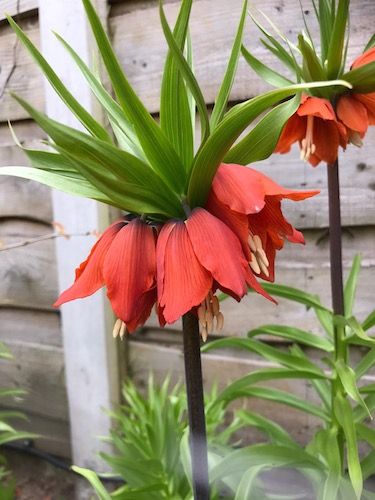
Fritillaria Imperialis Rubra Maxima
30% off Autumn Planted Bulbs
Estimated shipping dates: Dispatched in 3-5 working days
- Dispatched in the planting window, September to November.
- Top-size, quality bulbs, carefully sourced and dispatched from our family-run nursery in Cheshire.
- Growing guarantee. If it fails to perform in its first season, tell us and we will put it right.
- Height
- 90-100cm / 35-39"
- Aspect
- Full Sun / Partial Shade
- Hardiness
- Hardy - H5 (-15°C to -10°C)
- Scented
- No
- Pollinator
- Yes
- Border position
- Middle
Planting and flowering
- Jan
- Feb
- Mar
- Apr
- May
- Jun
- Jul
- Aug
- Sep
- Oct
- Nov
- Dec
- Height
- 90-100cm / 35-39"
- Aspect
- Full Sun / Partial Shade
- Hardiness
- Hardy - H5 (-15°C to -10°C)
- Scented
- No
- Pollinator
- Yes
- Border position
- Middle
Planting and flowering
- Jan
- Feb
- Mar
- Apr
- May
- Jun
- Jul
- Aug
- Sep
- Oct
- Nov
- Dec
About Fritillaria Imperialis Rubra Maxima
Meet the queen of fritillaries—Fritillaria imperialis ‘Rubra Maxima’, a bold and brilliant red Crown Imperial that demands full attention in any spring garden. Standing tall with a sturdy stem adorned by glossy, lance-shaped leaves, this dramatic perennial makes a striking statement alongside spring favourites like tulips and hyacinths, bringing vibrant colour and architectural elegance.
At the summit of each stem, clusters of downward-facing, bell-shaped flowers are crowned by a rosette of small leaves—giving this regal plant its iconic name, “Kaiser’s Crown.” Beyond its beauty, Rubra Maxima releases a distinct scent that naturally repels mice, moles, and other rodents, making it as practical as it is stunning.
Perfect for sunny borders or mixed beds, this demanding beauty will brighten your spring with colour and charm, while helping protect your garden from pests.
For more information on how to plant and care for your Fritillaria
Full specification
- Also known as
- Crown Imperial, Kaiser's Crown, Fritillary
- Genus
- Fritillaria Imperialis
- Colours
- Red
- Planting period
- Autumn: September/October
- Height Range
- Tall
- Height
- 90-100cm / 35-39"
- Border position
- Middle
- Aspect
- Full Sun / Partial Shade
- Soil Type
- Loam, Sandy, Multipurpose Compost, Loam-based compost
- Bulb Size
- 24+
- Hardiness
- Hardy - H5 (-15°C to -10°C)
- Suitable for containers
- Yes
- Scented
- No
- Double Flowered
- No
- Pollinator
- Yes
- Toxicity
- No report
- Estimated shipping dates
- Dispatched in 3-5 working days
- Delivery period
- Autumn delivery (Oct to Dec 2026)
Planting
How to plant Fritillaria
- Fritillaria Imperialis should be planted in the Autumn for Spring flowering.
- Find a location with full sun or partial shade with well-drained, sandy soil, if necessary add sand, grit or gravel to be improve the condition of the area for planting.
- Arrange the bulbs in an odd-number grouping.
- If planting in the garden, plant the bulbs about 10-12" apart. Space the groupings at least 3 feet apart.
- If planting in pots, plant 1 bulb in a 6-8" pot using good-quality, multi-purpose compost, preferably adding sand to the hole to prevent the bulb from rotting.
- Plant the bulbs quite deep with 6-8" of soil above them.
- It is best to plant the Crown Imperial bulb on its side, this prevents water collecting at the top of the bulb and causing it to rot.
Care
How to care for Fritillaria
- Fritillaria Imperialis can tolerate very cold conditions but they do not like to get wet.
- If planting in borders in the garden, the soil must be well drained and, preferably, sandy.
- If planting in pots, make sure the Fritiallaria Imperialis are kept moist but do not get waterlogged.
- If planting in pots, it may be an idea to tilt the pots on their side in the winter to prevent waterlog.
- When the Fritiallaria Imperialis has finished flowering, cut any seed heads back and allow the foliage to die back naturally.
- Fritiallaria Imperialis bulbs will multiply during the first or second year of planting. Ideally, the best time to lift and check your bulbs for dividing is during the months of August and September. Once, you have divided your bulbs, they will all need replanting.
- Once the Fritiallaria Imperialis start to grow, keep a look out for Scarlet Lily Beetle. See FAQ on 'How do I get rid of Lily Beetle?'. Prevent the Scarlet Lily beetle from ruining your Fritillarias by using our Lily Beetle Prevention spray.
Be the first to share your thoughts on this variety.
Frequently asked
Can you tell me why the foliage is going yellow?
This question was asked by
Good afternoon,
When your Fritillaria Imperialis' (Crown Imperial) foliage turns yellow, is when the plant stocks up on nutrients and energy for the next blooming cycle.
Loraine Hart
Hi. I bought bulbs for Fritillaria Imperialis Rubra, Amarine Belladiva Anastasia and Amarine Belladiva Emanuelle from your stall at the Hampton Court Flower Festival. I checked online and I think I can plant the fritillaria bulbs in Autumn but when should I plant amarine bulbs? Should I plant them straight away?
This question was asked by
Hi
Yes, plant your amarines straight away and they will flower later this year.
Your crown imperials need planting in the autumn so store them someone cool and dry until you plant them.
The Hart Family
general test
Send it over and one of our growers will reply — usually the same day.