


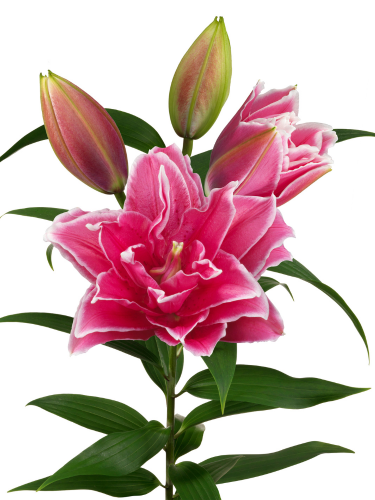
Roselily 'Mathilda'
Quantity pricing
Estimated shipping dates: Spring 2027
- Dispatched in the planting window, February to May.
- Top-size, quality bulbs, carefully sourced and dispatched from our family-run nursery in Cheshire.
- Growing guarantee. If it fails to perform in its first season, tell us and we will put it right.
- Height
- 70-100cm / 28-39"
- Aspect
- Full Sun / Partial Shade
- Hardiness
- Very Hardy - H6 (-20°C to -15°C)
- Scented
- Yes
- Pollinator
- Yes
- Border position
- Middle/Back
Planting and flowering
- Jan
- Feb
- Mar
- Apr
- May
- Jun
- Jul
- Aug
- Sep
- Oct
- Nov
- Dec
- Height
- 70-100cm / 28-39"
- Aspect
- Full Sun / Partial Shade
- Hardiness
- Very Hardy - H6 (-20°C to -15°C)
- Scented
- Yes
- Pollinator
- Yes
- Border position
- Middle/Back
Planting and flowering
- Jan
- Feb
- Mar
- Apr
- May
- Jun
- Jul
- Aug
- Sep
- Oct
- Nov
- Dec
About Roselily 'Mathilda'
Roselily 'Mathilda' is one our newest Roselilies. It produces beautiful, full flowers that may need some support due to their glorious size. These lilies can be planted in the garden or pots. They do like Acidic soil so if your garden has an alkaline soil then we would advise planting in pots with Ericaceous compost. Try using John Innes No. 3 compost.
Click here - For more information on how to choose, plant and grow lilies.
* Please note - Although these lilies are listed as 'Pollen-free Lilies', in extreme weather conditions, lilies can get stressed and, in turn, this can cause the lilies to produce stamen.
** As with lots of plants/flowers in the garden, lilies are toxic to pets if ingested. Not just the stamen but the foliage and flowers too. Pets do not tend to eat lilies but the problem with lilies occurs when cats or dogs brush past the stamen and then lick if off their fur. We advise opting for pollen-free lilies and keeping your lilies up high and away from fences or windowsills where cats can easily brush against the flower heads that have stamen.
Full specification
- Also known as
- Roselily, Double Oriental Lily
- Genus
- Lilium Oriental Roselily
- Colours
- Pink
- Planting period
- Spring
- Height Range
- Tall
- Height
- 70-100cm / 28-39"
- Border position
- Middle/Back
- Aspect
- Full Sun / Partial Shade
- Soil Type
- Garden: Acidic Soil | Pots: Ericaceous or Multipurpose Compost with added Grit
- Bulb Size
- 16/18cm
- Hardiness
- Very Hardy - H6 (-20°C to -15°C)
- Suitable for containers
- Yes
- Scented
- Yes
- Double Flowered
- Yes
- Pollinator
- Yes
- Toxicity
- No report
- Estimated shipping dates
- Spring 2027
- Delivery period
- Spring (Feb to May 2027)
Planting
How to plant Roselilies
- Roselily Bulbs should be planted as soon as possible. Ideally in the Spring but can be planted up until the Autumn.
- Find a location with full sun or partial shade with well-drained soil.
- Roselilies tend to grow exceptionally well in pots and tubs.
- Plant the bulbs with 4-6" of soil above them.
Planting Roselilies in the Garden
- Find a location with full sun or partial shade with well-drained soil.
- Roselilies prefer an Acidic/Ericaceous Soil type. They do not tolerate Lime very well.
- Arrange the Lilies in an odd-number grouping.
- Plant the bulbs about 12-20cm (5-8") apart.
- Space the groupings at least 60-90cm (2-3ft) apart.
- Plant the bulbs with 10-15cm (4-6") of soil above them.
Planting Roselilies in Pots
- Find a location with full sun or partial shade with well-drained soil.
- Plant 5 bulbs in a 15 litre (15" in diameter) 'patio type' pot using good-quality, multi-purpose compost with added grit.
- Plant the bulbs with 10-15" (4-6") of soil above them.
- Ensure there is adequate drainage.
Care
How to care for Roselilies
- Roselilies can tolerate very cold conditions but they do not like to get wet.
- If planting in borders in the garden, the soil must be well drained and, preferably, humus rich.
- If planting in pots, make sure lilies are kept moist but do not get waterlogged.
- Lilies prefer to be planted in a location with at least half a day’s full sunshine, if it’s a bit too shady they will lean their stems towards the sun.
- Lily bulbs do not like to be dried out so they must be kept in soil at all times.
- Try to plant your lilies where they will dry out after rain to prevent Botrytis, a fungus that spots the leaves. If you do see brown spots on your leaves, spray with a fungicide recommended for roses.
- If planting in pots, it may be an idea to tilt the pots on their side in the winter to prevent waterlog.
- When the Lily has finished flowering, cut any seed heads back and allow the foliage to die back naturally. Do not be tempted to cut the stem back until stems becomes hollow and brown.
- Lilies like a cold dormant phase throughout the winter so they don't need lifting. However, do ensure they have adequate drainage and do not get waterlogged as this will cause the bulbs to rot.
- After a few years of flowering, you may find your Roselily produces less blooms, it may be time to lift your bulbs and divide them by breaking off the bulblets. All the bulbs will then need replanting.
- To prevent Lily Beetles from damaging your lilies, we recommend using the Lily Beetle Prevention Spray or you can make up your own with the Concentrate. This Spray (Grazers G4) will also stimulate growth of your lilies.
- You can feed your lilies with a Tomato Feed to stimulate and strengthen your lilies when you start to see signs of growth. Make up your tomato feed with half the recommended dilution (written on the instructions on the bottle) and feed once every 3 weeks.
Be the first to share your thoughts on this variety.
Frequently asked
general test
Send it over and one of our growers will reply — usually the same day.